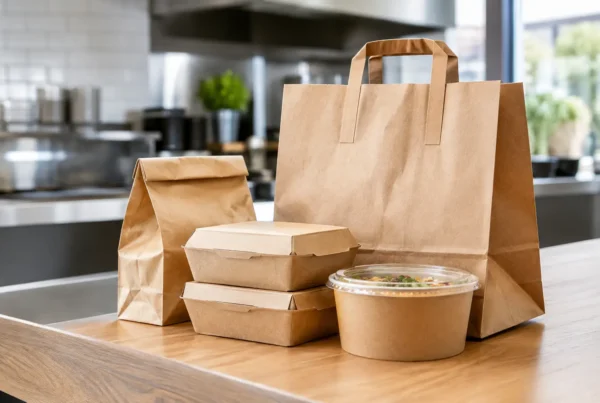
A printed carrier is often the last thing a customer sees before they leave your shop, venue or collection point. It needs to carry the purchase comfortably, look right for your brand and perform reliably in real use. Knowing how to specify printed carriers means turning those practical requirements into a clear brief that delivers the right bag at the right price.
A good specification avoids two expensive problems: paying for features you do not need, or choosing a bag that feels too light, too small or too ordinary for the products and experience you are selling. Start with the job the bag must do, then work through material, size, construction, print and ordering requirements.
How to specify printed carriers from the start
Before choosing a material or approving artwork, define the purpose of the carrier. A fashion retailer may need a strong, reusable bag that becomes part of the customer experience. A takeaway business needs a practical format that can manage hot or chilled food packaging. An event organiser may prioritise a bold printed bag that gives sponsors and visitors visibility well beyond the venue.
Ask what is going into the bag, how far it will be carried and what the customer should feel when they receive it. Weight matters, but so do awkward shapes, sharp corners, moisture and whether the bag will be reused. A small boutique purchase and a box of bottled products can require very different specifications, even if the overall bag size appears similar.
It also helps to decide whether the carrier is primarily a functional item, a branded retail touchpoint or both. The more visible the bag is in shops, high streets, exhibitions and hospitality settings, the more attention should be given to print quality, colour consistency and a design that can be recognised at a glance.
Set out the product and carrying requirements
Give your manufacturer as much useful detail as possible. The essential information includes the type of goods, typical weight per bag, largest item dimensions, expected daily or seasonal volumes and whether goods need extra protection. If your products vary greatly, specify for the heaviest or most demanding purchase rather than the average transaction.
For food and delivery applications, explain whether the bag will hold containers, cups, chilled items or products that may create condensation. A bag suited to dry retail goods may not be the right choice for food packaging. If stock will be stored in a back room, vehicle or warehouse, consider the conditions it will face before it reaches customers as well.
Choose the right carrier material
The material affects appearance, strength, handling, cost and the environmental options available to your business. There is no single best choice. The right material depends on how the bag will be used and the message your brand needs to communicate.
Plastic carrier bags remain a practical option where strength, moisture resistance and economical volume pricing matter. They can be produced in a range of thicknesses and finishes, from lightweight formats for lower-weight purchases to stronger bags designed for repeat use. A heavier-gauge reusable bag may cost more per unit, but can deliver more brand exposure if customers keep it.
Printed paper bags offer a natural retail presentation and work particularly well for boutiques, gifts, food-to-go, cafés and premium products. Consider whether you need a flat-handle, twisted-handle or rope-handle format. Handles influence both carrying comfort and perceived value, so they should be selected alongside the bag’s expected load.
For businesses replacing conventional single-use plastic, alternatives such as potato starch, sugar cane, cotton and jute can offer different benefits. Compostable or plant-based options need to be chosen with care, based on the disposal route available to your customers and the claims you intend to make. Reusable cotton and jute bags can create a longer-life promotional product, although they are usually better suited to higher-value retail, events or merchandise than high-volume everyday transactions.
Recyclability, compostability and reuse are not interchangeable terms. Be precise in your messaging and make sure the environmental credentials of the finished bag, including any printing and added components, match the claim used on the artwork.
Select a size that works in practice
Carrier dimensions are normally considered as width, gusset and height. The gusset is particularly important because it gives the bag depth for boxed products, food containers or several items together. A carrier that looks generous when flat can quickly become restrictive once it is filled.
Measure your largest regular product with its protective packaging included. Allow enough room for staff to pack efficiently without forcing items into the bag or folding products in a way that damages their presentation. If you sell a mix of small and large products, two bag sizes can be more efficient than one oversized format used for every purchase.
Avoid specifying a bag simply because it matches a competitor’s dimensions. Their products, packing method and brand position may be different. A well-sized carrier reduces material waste, controls cost and looks more considered in the customer’s hand.
Match the handles and construction to the load
Handles are a performance feature, not just a visual detail. Die-cut handles provide a clean, simple finish for many plastic carrier formats. Patch handles add reinforcement around the grip area, making them suitable for heavier items. Loop handles offer a comfortable hold and can give a stronger retail appearance, while paper carrier bags may use flat, twisted or rope handles depending on the required look and load.
Consider how long customers are likely to carry the bag. A handle that is adequate for a quick trip from till to car may be less comfortable for a customer walking through town or travelling by public transport. For heavier products, tell the manufacturer the expected weight so the handle attachment and material specification can be selected appropriately.
Seal construction matters too. Bottom gussets, side gussets and reinforced areas should support the way the goods sit in the bag. Products with corners, bottles or dense contents can put pressure on seams that a lighter retail purchase would not. Where performance is critical, request samples and test them with your actual products before committing to a full production run.
Plan the print before finalising the bag
Your logo file is only one part of a print specification. Explain where you want the design to appear, whether it should be printed on one side or both, how many colours are required and whether colour matching is essential. Single-colour printing can be highly effective for clean, recognisable branding and is often a commercially efficient choice. Multi-colour spot printing is useful where your identity depends on distinct brand colours, illustrations or stronger visual impact.
Keep in mind that material and finish affect how ink appears. A design printed on natural paper will not look identical to the same artwork on a white plastic carrier or a darker reusable fabric. Fine detail, very small text and pale colours may need adjustment to remain clear at normal viewing distance.
Think about the bag as a moving advertisement. A large logo, readable web address or simple campaign line often works better than trying to fit every product message onto the available space. The best printed carriers are easy to identify from a few metres away and still look professional when carried, folded or partly filled.
Provide print-ready artwork where possible, ideally in a suitable vector format, and check proofs carefully before production. Confirm the orientation of the design, print area, colours, spelling, contact details and any sustainability statements. A proof is the point to resolve uncertainty, not a formality to approve quickly.
Balance quantities, lead times and unit cost
Your order quantity has a direct impact on unit cost. Larger production runs usually reduce the price per bag, but the lowest unit price is not automatically the best buying decision if stock takes up valuable space or your artwork is likely to change. Consider your normal usage, seasonal peaks and how long you expect the design to remain current.
For a growing business, it can be sensible to begin with a quantity that provides a worthwhile print price without creating unnecessary stock risk. Established retailers and wholesale users may benefit from planned call-offs or repeat orders, particularly where demand is predictable. A UK manufacturer can help you make practical decisions around lead times, storage and repeat production.
Build in time for artwork approval, samples and production, especially when launching a new shop, campaign or event. Leaving packaging until the final week can limit your choice of material, print method and delivery schedule.
Check compliance and customer expectations
Carrier bag rules and charges can vary across the UK and may change over time, so check the requirements that apply to your business location, bag type and use case. Food businesses should also ensure that packaging is appropriate for its intended contact and handling conditions.
Beyond formal requirements, customers increasingly notice whether packaging matches a brand’s stated values. A premium independent retailer using a thin, poorly printed carrier sends a different message from one using a well-designed reusable bag. Equally, an unnecessarily heavy bag can add cost and material without improving the customer experience. The aim is credible, fit-for-purpose packaging rather than a claim-led specification.
When you can clearly explain what the bag carries, how it is used, how it should look and how many you need, a manufacturer can turn that brief into a dependable finished product. At Oversolve, we can help guide businesses through material, format, printing and quantity choices so the finished carrier works as hard for the brand as it does for the customer.